Gigabit Ethernet vs 2.5G Ethernet
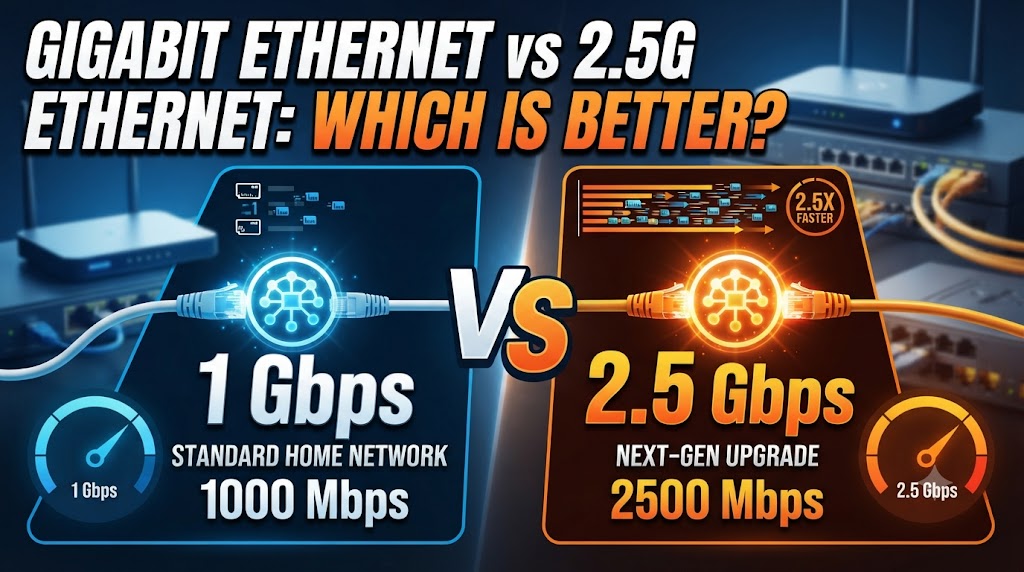
Gigabit Ethernet and 2.5G Ethernet are both wired networking technologies designed to provide fast network connections. Gigabit Ethernet supports speeds of up to 1 Gbps, while 2.5G Ethernet can provide speeds of up to 2.5 Gbps. This makes 2.5G Ethernet capable of delivering up to 2.5 times the link speed of Gigabit Ethernet.
For everyday internet browsing and standard home networking, Gigabit Ethernet can be sufficient. However, 2.5G Ethernet can be useful when you have a high-speed internet connection, a fast NAS, multiple users transferring large files, or newer networking equipment that supports 2.5GbE.
Quick Comparison: Gigabit Ethernet vs 2.5G Ethernet
| Feature | Gigabit Ethernet | 2.5G Ethernet |
|---|---|---|
| Maximum Link Speed | 1 Gbps | 2.5 Gbps |
| Speed Advantage | Lower | Up to 2.5× higher |
| Common Standard | 1000BASE-T | 2.5GBASE-T |
| Typical Cable | Cat5e or better | Cat5e or better |
| Large File Transfers | Fast | Faster |
| High-Speed Internet | Up to around 1 Gbps | Better for connections above 1 Gbps |
| NAS/Local Transfers | Suitable | Better for high-speed transfers |
| Availability | Very common | Increasingly common |
| Cost | Usually lower | Usually higher |
| Best Use | Standard networks | High-speed modern networks |
Speed: Gigabit Ethernet vs 2.5G Ethernet
Gigabit Ethernet provides a maximum link speed of 1 Gbps, while 2.5G Ethernet provides up to 2.5 Gbps.
This means a 2.5G Ethernet connection has 2.5 times the theoretical link capacity of Gigabit Ethernet.
The actual data-transfer speed will depend on the connected devices, network hardware, cables, storage performance, and network conditions.
Advantage: 2.5G Ethernet
Gigabit Ethernet vs 2.5G Ethernet for Internet
For an internet connection of 1 Gbps or less, Gigabit Ethernet can generally provide enough link capacity.
If your internet service is faster than 1 Gbps, a Gigabit Ethernet port can become a bottleneck. A 2.5G Ethernet port provides more network capacity and is therefore better suited to multi-gigabit internet connections.
For example, a 2 Gbps internet plan cannot be fully utilized by a single 1 Gbps Ethernet connection.
Advantage: 2.5G Ethernet
File Transfer Performance
Gigabit Ethernet is already considerably faster than older 100 Mbps Ethernet and works well for many everyday file-transfer tasks.
2.5G Ethernet provides additional bandwidth for moving large files between compatible computers, servers, and NAS devices. The improvement is most noticeable when both ends of the connection support 2.5GbE and the storage devices are fast enough to take advantage of it.
Advantage: 2.5G Ethernet
Cable Requirements
Both Gigabit Ethernet and 2.5G Ethernet can work over Cat5e or better twisted-pair cabling under appropriate conditions.
This is important because upgrading from Gigabit Ethernet to 2.5G Ethernet may not always require replacing an existing Cat5e installation.
However, cable quality, installation, connectors, distance, and equipment capabilities can affect the achievable connection speed.
Advantage: Tie
Gigabit Ethernet vs 2.5G Ethernet for Home Networking
Gigabit Ethernet is suitable for many homes because 1 Gbps provides substantial bandwidth for browsing, streaming, gaming, smart TVs, computers, and other connected devices.
2.5G Ethernet becomes more useful when a home has multi-gigabit internet, a high-performance NAS, multiple computers transferring large files, or newer networking equipment.
For a basic home network, the additional speed of 2.5G Ethernet may not provide a noticeable benefit in every activity.
Advantage: Depends
Gigabit Ethernet vs 2.5G Ethernet for Gaming
Both technologies can provide more than enough bandwidth for most online gaming connections.
Gaming performance is affected by factors such as latency, server distance, Wi-Fi conditions, routing, and internet service quality. Simply moving from 1 Gbps to 2.5 Gbps does not automatically reduce gaming latency.
However, 2.5G Ethernet can provide more bandwidth for downloading large games, updates, and other data when the internet connection and gaming hardware support it.
Advantage: Depends
Gigabit Ethernet vs 2.5G Ethernet for NAS
A NAS can benefit from faster Ethernet when multiple devices access files or when transferring large amounts of data.
Gigabit Ethernet provides up to 1 Gbps of network bandwidth, while 2.5G Ethernet provides up to 2.5 Gbps. A NAS, switch, computer, and network storage system must all support the faster connection to achieve the higher link speed.
For users with compatible hardware and frequent large file transfers, 2.5G Ethernet provides more bandwidth.
Advantage: 2.5G Ethernet
Cost
Gigabit Ethernet hardware is widely available and is often included in routers, switches, motherboards, and network adapters.
2.5G Ethernet hardware can cost more, although 2.5GbE support has become increasingly available in newer networking equipment.
If you only need a 1 Gbps connection, paying extra for 2.5G Ethernet may not be necessary. If you already use multi-gigabit equipment, the additional cost can provide useful extra bandwidth.
Advantage: Depends
Power Consumption
Power consumption depends on the specific Ethernet controller, switch, router, network adapter, and other hardware.
Therefore, it would not be accurate to assume that either Gigabit Ethernet or 2.5G Ethernet always consumes less power.
Advantage: Depends
Which Is Better for Future Upgrades?
Gigabit Ethernet remains useful for many standard networks, but 2.5G Ethernet provides additional bandwidth for future higher-speed internet connections and local network transfers.
If you are purchasing new networking equipment and the price difference is acceptable, 2.5G Ethernet can provide more capacity without requiring a completely different type of copper Ethernet infrastructure in many existing installations.
Advantage: 2.5G Ethernet
Gigabit Ethernet vs 2.5G Ethernet: Which Should You Choose?
Choose Gigabit Ethernet if:
- Your internet connection is 1 Gbps or less.
- You mainly browse, stream, and use normal online services.
- You do not frequently transfer very large files.
- Your existing network already uses Gigabit Ethernet.
- You want a straightforward and widely supported network setup.
Choose 2.5G Ethernet if:
- You have internet faster than 1 Gbps.
- You frequently transfer large files.
- You use a high-speed NAS.
- You have multiple high-performance wired devices.
- Your router, switch, computer, and other hardware support 2.5GbE.
- You want additional network bandwidth for future upgrades.
Overall Winner: 2.5G Ethernet
For networks that can actually use its additional bandwidth, 2.5G Ethernet provides higher performance because its maximum link speed is 2.5 times that of Gigabit Ethernet.
Gigabit Ethernet remains sufficient for many homes and offices, especially where internet speeds and local data-transfer requirements stay within 1 Gbps. The practical choice therefore depends on the capabilities and requirements of the complete network.
Disclaimer
Ethernet speeds mentioned in this comparison are maximum theoretical link speeds. Actual performance can vary depending on network hardware, cable quality, distance, storage devices, internet service, network traffic, and other factors. Product specifications and prices may also change over time.